
7 October 2026 · Buddha Overseas
Dehydrated onion and garlic cuts, mesh and bulk density
Kibbled, minced, granules or powder: what each cut is for, why mesh numbers are ambiguous, the Codex limits on dried garlic, and how density fills a box.
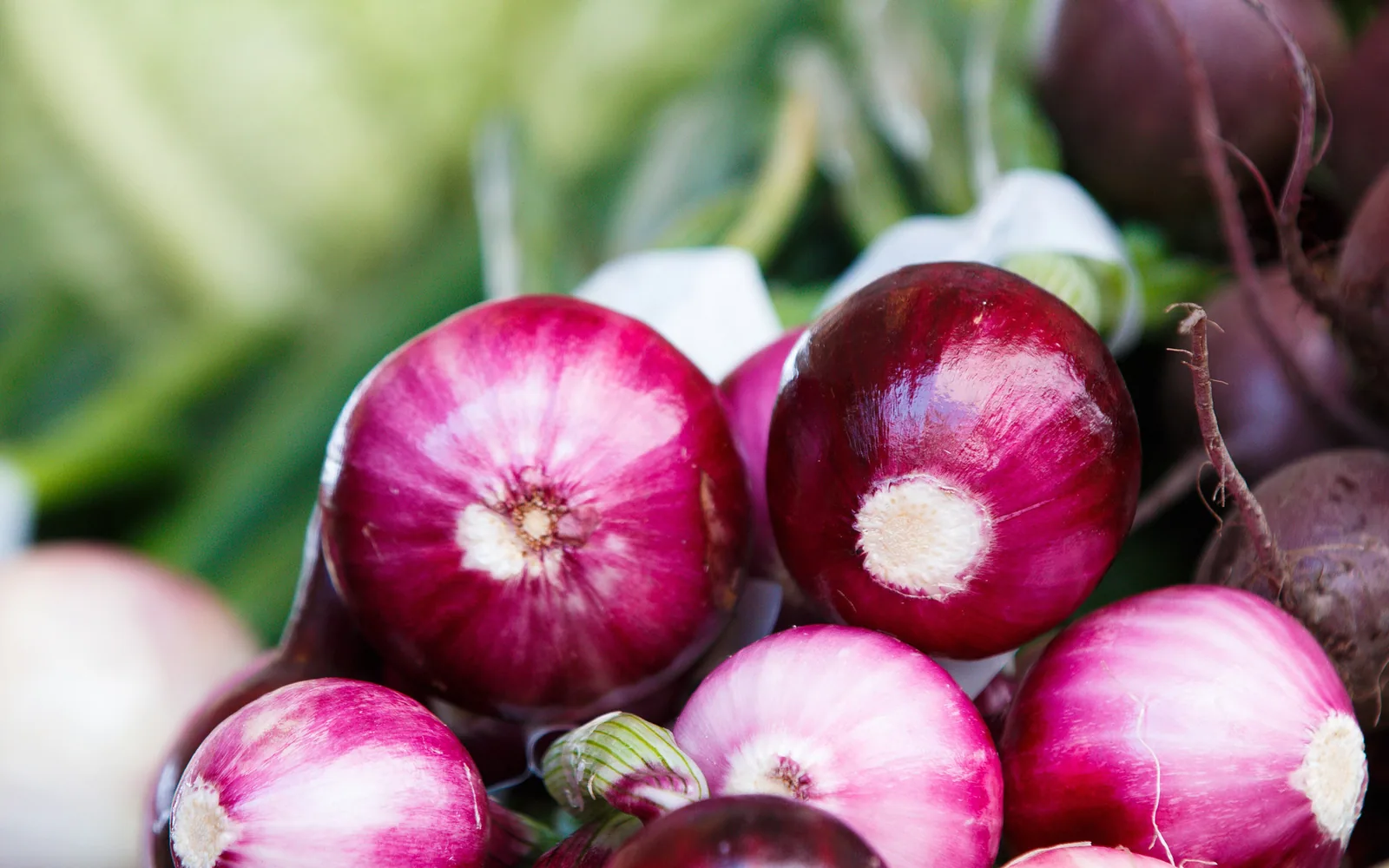
The cut you order for dehydrated onion and garlic decides three things at once: how the product behaves in your process, how it is tested, and how much of it fits in a container. Buyers often fix the first and discover the other two after the goods have shipped. This is what to settle before you issue the purchase specification.
The cut ladder, from slice to powder
There is no universal naming convention, which is the root of most disputes. In rough order of decreasing particle size, the trade uses: whole or half cloves, sliced, kibbled (large flake), chopped, minced, granulated, and powder. One supplier's "minced" is another's "chopped". Codex is no help here either — the Standard for dried or dehydrated garlic, CXS 347-2019, defines the product as whole (peeled dry cloves or intact cloves), cracked or broken, ground or powdered, and "other styles", which leaves the middle of the ladder open.
So do not order by name. Order by dimension: a nominal particle size range in millimetres for flakes and chopped material (for example 3 to 5 mm), and an aperture-based specification for granules and powder. Put the name in brackets afterwards if you like, but the dimension governs.
Mesh is not a specification on its own
"40 mesh" means different apertures depending on which sieve series you mean — the ASTM, Tyler and British series do not line up. A buyer who writes "100 mesh" and a producer who reads it against a different series can both believe they are right.
Write the aperture in microns, name the sieve standard you are referencing, and state the pass or retain percentage and the method. "Minimum 95 per cent passing a 250 micron aperture sieve" is enforceable. "100 mesh" is not. The same applies to the coarse end: give a range with the proportion of fines you will accept, because every flake cut generates some dust in handling and transport, and a zero-fines clause is a claim waiting to happen.
What Codex actually fixes for dried garlic
CXS 347-2019 sets chemical limits rather than cut. Moisture is capped at 7.0 per cent w/w for powdered garlic and 8.0 per cent for other forms. Total ash is a maximum of 6.0 per cent on a dry basis and acid-insoluble ash a maximum of 0.5 per cent — the acid-insoluble figure is the one that catches soil and grit. Volatile organic sulphur compounds have a minimum of 0.3 per cent m/m on a dry basis, which is as close as the standard gets to a strength measure.
Two cautions. First, the scope of that standard covers product for direct consumption, as a food ingredient or for repacking, and explicitly excludes product intended for industrial processing — so if you are buying for extraction or further manufacture, naming Codex may not do what you think. Second, we are not aware of a directly equivalent Codex commodity standard for dried onion. If your contract says "Codex", say which standard. Otherwise the onion parameters are whatever you and the supplier write down.
Bulk density decides whether the container weighs out or cubes out
Dehydrated onion and garlic are light. Flakes and kibbled cuts trap a lot of air between particles; granules pack tighter; powder tighter still. The practical consequence is that a flake container usually fills on volume long before it reaches payload, while a powder container can approach weight limits. Both are inefficient if you did not plan for them.
The arithmetic is simple and worth doing before you confirm:
- Ask for the packed density of the finished pack, not the loose density of the product. A carton of flakes compressed at packing behaves differently from a sample in a beaker.
- Ask for carton or bag external dimensions, net weight and gross weight.
- Work out how many packs fit a pallet footprint and how many tiers your container height allows, then multiply.
This is also where your pack format earns or loses money. Cartons stack squarely and protect friable flakes; multiwall paper bags with a food-grade liner take less tare and suit powders and granules. Mixed loads of several cuts are usually the sensible answer, and our minimum is 1,000 kg per product, so a container can carry several specifications. Our full range of cuts sits under Dehydrated Onion & Garlic.
Matching the cut to the application
- Flakes and kibbled: visible pieces in soups, pickles, dry seasoning for snacks, retail blends. Rehydration speed matters more than flow.
- Chopped and minced: sauces, ready meals, meat preparations where the piece should be present but not identified.
- Granules: dry blends and rubs. The reason to choose granules over powder is segregation — if your blend contains salt, sugar or a coarse spice, matching particle size stops the fine fraction migrating to the bottom of the sack during road and sea transport.
- Powder: emulsions, marinades, extrusion, instant mixes. Powders are hygroscopic and cake; they also carry a higher handling risk microbiologically because of the extra milling and sieving steps.
If you specify an anticaking agent, name the substance and the level, and confirm it is permitted and correctly declared in your destination market. A free-flowing powder that cannot be labelled is a dead container.
Testing changes with the cut
A finer cut means more surface area, more handling and a different microbiological profile from the same raw material. Ethylene oxide is not an option for EU-bound goods, so for powders and granules the control has to be process hygiene plus testing, lot by lot. We test every lot before shipment and the certificates of analysis travel with the documents — what we test and where is set out on quality, and the sequence from quotation to delivery is on export process.
A practical note
Agree a retained sample and a tolerance band for particle size at the quotation stage, not after arrival. Dried allium is a natural product and sieve results drift within a lot. A specification that allows a stated percentage outside the nominal range, with a named test method, is far cheaper to administer than one that reads as absolute and is never quite met. If you tell us the application and the destination, we can quote the cut that suits it — contact.
Sources
- Codex CXS 347-2019 Standard for dried or dehydrated garlic: scope (direct consumption, ingredient, repacking; excludes product for industrial processing), product definition styles (whole, cracked/broken, ground/powdered, other styles), and Table A1 chemical limits - moisture max 7.0% for powdered and 8.0% for other forms, total ash max 6.0% dry basis, acid-insoluble ash max 0.5% dry basis, volatile organic sulphur compounds min 0.3% m/m dry basis. — fao.org
Looking for a supplier?
Every product page carries its specifications, packing, container load and export-policy note. Tell us the item and quantity and you get a quotation with the exact figures for your market.
Get a quoteMore articles
19 October 2026
Buying Indian groundnuts under the APEDA procedure
12 October 2026
APEDA rice contract registration and your lead time
5 October 2026